LA28 FIBA 3×3 Basketball Court Dimensions and Equipment Requirements
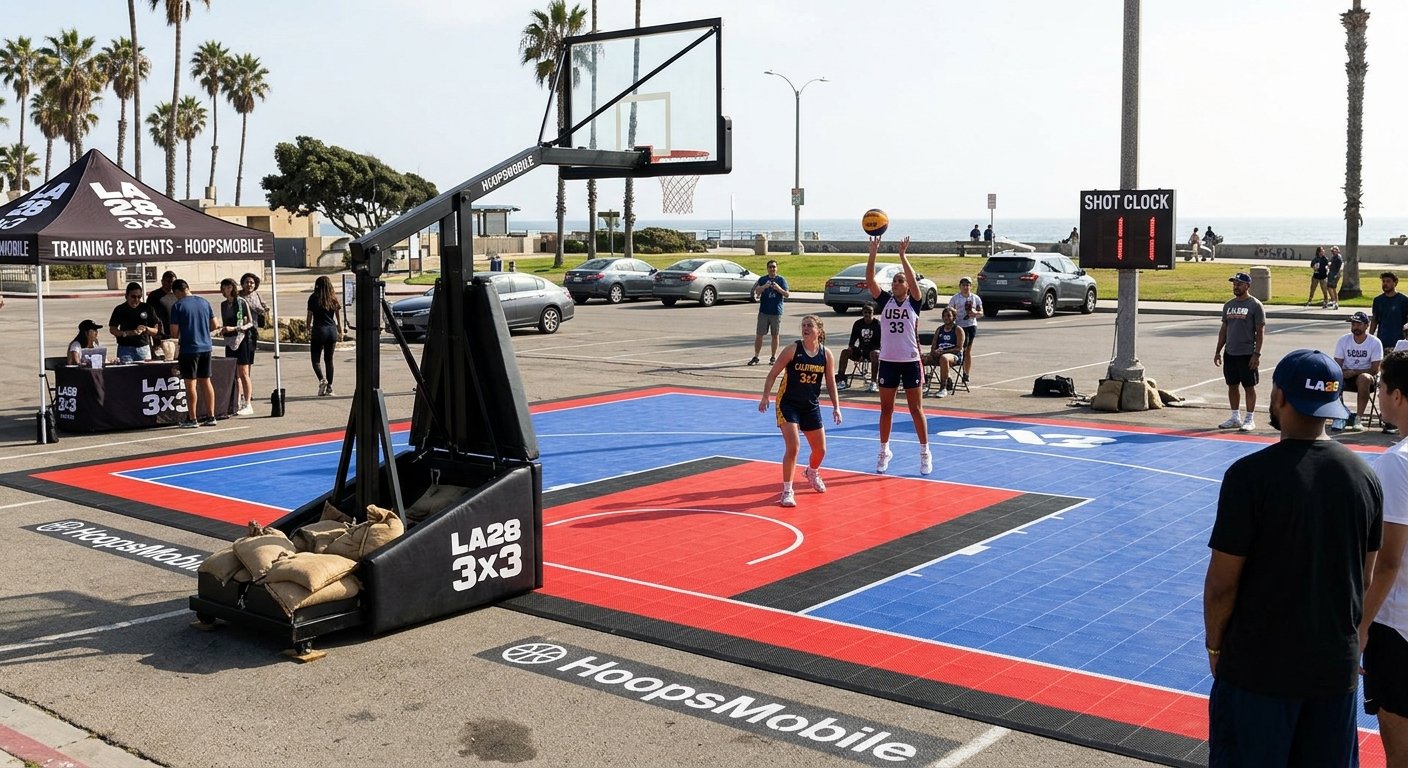
Planning a 3×3 basketball training facility or event in Los Angeles ahead of LA28? Understanding court dimensions, equipment requirements, and installation conditions is an important first step.
FIBA 3×3 basketball has specific court and equipment requirements that differ from those used for a traditional full-court 5×5 basketball setup. Teams, sports federations, event organizers, and facility planners should consider these differences when selecting a venue, sourcing equipment, and planning a temporary court installation.
This guide covers standard FIBA 3×3 court dimensions, essential equipment, playing-surface considerations, and practical steps for planning a 3×3 basketball setup in Los Angeles.
The exact requirements for a project should always be checked against the current official FIBA rules and the specifications provided by the responsible organizer or federation.
1. What Are the Standard FIBA 3×3 Basketball Court Dimensions?
A standard FIBA 3×3 basketball playing court measures:
- Length: 15 meters
- Width: 11 meters
- Playing area: 165 square meters
The standard playing area is rectangular and includes the required court markings.
These dimensions provide a starting point when evaluating a venue or planning a temporary 3×3 basketball court. However, the playing area is not necessarily the same as the total space required for installation.
Additional space may be needed around the court for player movement, equipment positioning, safety clearances, access routes, spectators, officials, and event operations.
For this reason, organizers should distinguish between the official playing dimensions and the overall footprint required at the venue.
Converting the dimensions to feet
For preliminary planning, the standard 15 m × 11 m playing area is approximately:
- Length: 49.2 feet
- Width: 36.1 feet
- Area: 1,776 square feet
These conversions are useful when assessing venues in the United States.
Actual installation requirements should be established using the project’s approved layout and the available site measurements.
2. Understanding the 3×3 Court Layout
A 3×3 basketball court is designed for play toward a single basket. Its layout includes the basket area, the free-throw line, the two-point arc, and other markings specified by the applicable rules.
When planning a temporary court, organizers should confirm that the proposed layout follows the relevant 3×3 requirements.
Important considerations include:
- Correct court dimensions and orientation.
- Accurate positioning of the basket and court markings.
- Appropriate free-throw line and two-point arc markings.
- Suitable playing-surface conditions.
- Sufficient clearance around the playing area.
- Space for players, officials, and required equipment.
Court markings should be planned before the flooring or marking system is ordered.
If a modular sports floor or another temporary surface is being installed, the layout should be coordinated with the actual product dimensions and installation method.
Why layout planning matters
A court can have the correct overall dimensions but still require adjustments if its markings, basket position, or surrounding clearances are unsuitable.
For temporary training facilities and sports events, confirming the complete layout in advance helps reduce installation changes and avoidable delays.
3. What Basketball Hoop Is Required for a 3×3 Court?
A standard 3×3 basketball setup uses one basket.
The basket height is generally 3.05 meters (10 feet), consistent with standard basketball basket height requirements.
However, the selection of a hoop system involves more than confirming basket height.
Depending on the project, organizers may need to evaluate:
- Basket support structure.
- Backboard specifications.
- Rim and net configuration.
- Padding and safety requirements.
- Stability and installation method.
- Compatibility with the playing surface and venue.
- Applicable technical or FIBA approval requirements.
A temporary court may require a freestanding or portable basketball system rather than a permanently installed basket.
In that situation, the venue’s surface, access route, available installation space, and the system manufacturer’s instructions must all be considered.
Does the hoop need to be FIBA-approved?
The answer depends on the applicable requirements for the intended use.
If a project specifically requires a FIBA-approved hoop system, verify the exact manufacturer, model, and relevant documentation.
A recognized brand name or a professional appearance does not, by itself, establish a product’s current approval status.
For more information, read our guide to how to verify FIBA approval for basketball equipment.
4. Which Basketball Is Used for FIBA 3×3?
FIBA 3×3 uses a specific basketball specification.
The standard 3×3 ball combines size 6 dimensions with the weight of a size 7 basketball. This specification distinguishes the official 3×3 ball from a conventional size 6 or size 7 basketball.
For a training program or event, confirm the required ball specification before arranging a purchase or rental.
Consider the following:
- Required ball specification.
- Quantity needed for training and warm-ups.
- Intended playing level and program.
- Manufacturer and model.
- Any applicable approval or technical requirements.
- Availability for the required dates.
Teams may also need ball carts or storage equipment to support daily training operations.
The final equipment list should reflect the requirements of the responsible organization and the intended use of the court.
5. Is a 12-Second Shot Clock Required?
The 3×3 format uses a 12-second shot clock.
For a setup that requires a shot clock, organizers should plan for equipment capable of meeting the applicable functional and technical requirements.
Depending on the project, the equipment plan may need to account for:
- Shot-clock functionality.
- Visibility from the playing area.
- Mounting or positioning arrangements.
- Power and connectivity requirements.
- Compatibility with the proposed hoop system.
- Installation, operation, and removal.
The precise equipment configuration depends on the venue, the intended use, and the event’s requirements.
For a temporary court, shot-clock positioning should be considered during layout planning rather than after the hoop and flooring have been installed.
6. Choosing the Right Playing Surface
The playing surface is a major consideration when planning a temporary 3×3 court.
Depending on the venue and project, possible options may include an existing suitable sports floor or a temporary modular sports flooring system.
The right option depends on the installation environment, the intended use, the available surface, and the project’s technical requirements.
Indoor installations
For an indoor court, review:
- The condition and suitability of the underlying floor.
- Available installation space.
- Surface protection requirements.
- Access routes and delivery restrictions.
- Flooring dimensions and court markings.
- Installation and removal schedules.
The existing venue floor should be assessed before deciding whether an additional temporary surface is appropriate.
Outdoor installations
Outdoor projects require additional attention to site conditions.
Consider:
- Whether the underlying surface is suitable.
- Drainage and water exposure.
- Weather conditions.
- Surface stability and levelness.
- The proposed flooring system’s installation requirements.
- Protection and storage of equipment during adverse weather.
A temporary sports floor should be selected for the intended application, not simply because it is available.
Does the flooring need FIBA approval?
If the project specification requires FIBA-approved flooring, verify the exact product and applicable approval category.
Do not assume that every modular sports floor is approved for every basketball application.
The playing surface, court layout, and installation conditions should be evaluated together.
Learn more about our basketball court flooring rental options for temporary basketball projects in Los Angeles.
7. What Equipment Is Needed for a 3×3 Basketball Setup?
The equipment list depends on whether the project involves a simple training setup, a temporary event court, or a more comprehensive competition-style environment.
A typical planning checklist may include the following:
| Equipment | Purpose | Key consideration |
|---|---|---|
| Basketball hoop system | Provides the basket for play | Model, specifications, stability, and installation |
| Backboard, rim, and net | Basket components | Compatibility and applicable technical requirements |
| 3×3 basketballs | Training and play | Required specification and quantity |
| 12-second shot clock | Supports the 3×3 format | Functionality, visibility, and installation |
| Court surface | Provides the playing area | Venue conditions, dimensions, and suitability |
| Court markings | Defines the playing layout | Accurate positioning and dimensions |
| Ball carts | Supports training operations | Capacity and storage needs |
| Additional accessories | Supports the event or training program | Confirmed project requirements |
Not every project needs every item listed.
For example, a venue may already have a suitable playing surface, while another project may require a complete temporary court installation.
Similarly, additional scoring equipment, seating, barriers, or event infrastructure may be necessary for some events but unnecessary for a basic training setup.
The most effective approach is to prepare an equipment schedule based on the actual requirements of the project.
8. How Much Space Is Needed Beyond the Court?
The standard 15 m × 11 m playing area should not be treated as the total space required for every installation.
The complete footprint may need to include:
- Safety and clearance areas.
- Hoop-system positioning and access.
- Space for equipment handling.
- Player and staff movement.
- Spectator areas, where applicable.
- Event infrastructure and circulation routes.
- Delivery and installation access.
The additional space required depends on the venue, the installation method, the equipment configuration, and the intended use.
Before confirming a site, measure the available area and compare it with the proposed court layout and the relevant technical requirements.
For temporary installations, it is also important to confirm the delivery route, loading area, access restrictions, and any limits on installation or dismantling times.
9. Temporary 3×3 Court Rental vs. Purchasing Equipment
Organizations planning basketball activities in Los Angeles may consider renting a temporary 3×3 court package or purchasing the required equipment.
The appropriate option depends on the length of use, availability, logistics, and future plans.
When rental may be suitable
Rental may be worth considering when:
- The court is needed for a limited training period.
- Equipment is required for a temporary event.
- International transportation would add complexity.
- Local delivery and installation support is valuable.
- The organization does not need to store the equipment afterward.
When purchasing may be suitable
Purchasing may be preferable when:
- The equipment will be used repeatedly.
- The organization is establishing a longer-term facility.
- A specific model is required for an extended period.
- The organization has suitable storage and handling arrangements.
The decision should account for the full project scope, including transport, installation, dismantling, storage, and any required technical documentation.
Neither rental nor purchase automatically guarantees that the equipment meets a particular FIBA requirement. The specific products and applicable documentation must still be checked.
10. Planning Delivery and Installation in Los Angeles
A temporary 3×3 basketball court requires more than transporting the equipment to the venue.
Successful installation depends on advance coordination between the equipment supplier, the venue, and the project organizer.
Before scheduling delivery, confirm:
- Site measurements: Verify the available area and proposed court layout.
- Venue access: Check loading access, vehicle restrictions, elevators, stairs, and handling requirements.
- Surface conditions: Confirm that the installation area is suitable for the proposed equipment.
- Equipment list: Establish which products and quantities are included.
- Installation schedule: Confirm when the venue will be available for setup.
- Technical requirements: Identify any required documentation or product specifications.
- Dismantling and collection: Agree on the removal window and return arrangements.
International teams should begin these discussions early enough to identify potential equipment sourcing or scheduling issues.
For a project involving multiple venues, each site should be assessed separately. Access conditions, installation requirements, and equipment needs may differ between locations.
11. Planning 3×3 Basketball Training Ahead of LA28
Teams preparing for basketball training in Los Angeles should start by defining their intended use and technical requirements.
A practical planning process includes:
- Confirming the 3×3 court layout.
- Identifying the required hoop system and basketball specification.
- Determining whether a shot clock and other equipment are needed.
- Evaluating the playing surface and available site.
- Verifying applicable technical and approval requirements.
- Comparing rental and purchase options.
- Coordinating delivery, installation, and removal.
Planning these details in advance can help organizations identify equipment needs before finalizing a venue or training schedule.
The final setup should be based on the project’s actual requirements and the current official rules and specifications relevant to the intended use.
12. 3×3 Basketball Court Rental in Los Angeles
HoopsMobile provides basketball equipment rental and related project support in Los Angeles and Southern California.
Depending on project requirements and availability, we can discuss temporary 3×3 court solutions, basketball hoop systems, selected sports flooring options, basketball equipment, and local delivery and installation coordination.
Our approach begins with understanding the project:
- What type of basketball activity are you planning?
- What court dimensions and equipment are required?
- Is the installation indoors or outdoors?
- What venue and delivery restrictions apply?
- What are the required delivery, setup, and removal dates?
- Are specific technical or product approval requirements part of the specification?
Providing these details helps establish a clearer scope for the equipment proposal.
Product availability, exact models, technical suitability, approval status, and installation arrangements must be confirmed for each project.
HoopsMobile is an independent service provider and does not claim to be an official LA28 or FIBA supplier.
Plan Your 3×3 Basketball Court
Planning a temporary 3×3 basketball court requires careful consideration of dimensions, equipment, playing surfaces, venue conditions, and installation logistics.
By preparing an equipment list and verifying the relevant technical requirements early, teams and organizers can make more informed decisions about their training or event setup in Los Angeles.
Planning a 3×3 basketball court for training or an event in Los Angeles?
Contact HoopsMobile to discuss temporary court solutions, basketball equipment rental, and local project support.
This article provides general planning information and does not replace current official FIBA rules, technical specifications, or project-specific requirements. Verify all applicable dimensions and equipment requirements with the responsible organization. HoopsMobile is an independent provider and is not affiliated with or endorsed by LA28 or FIBA.


