LA28 5×5 vs. 3×3 Basketball Training Equipment: What Teams Need
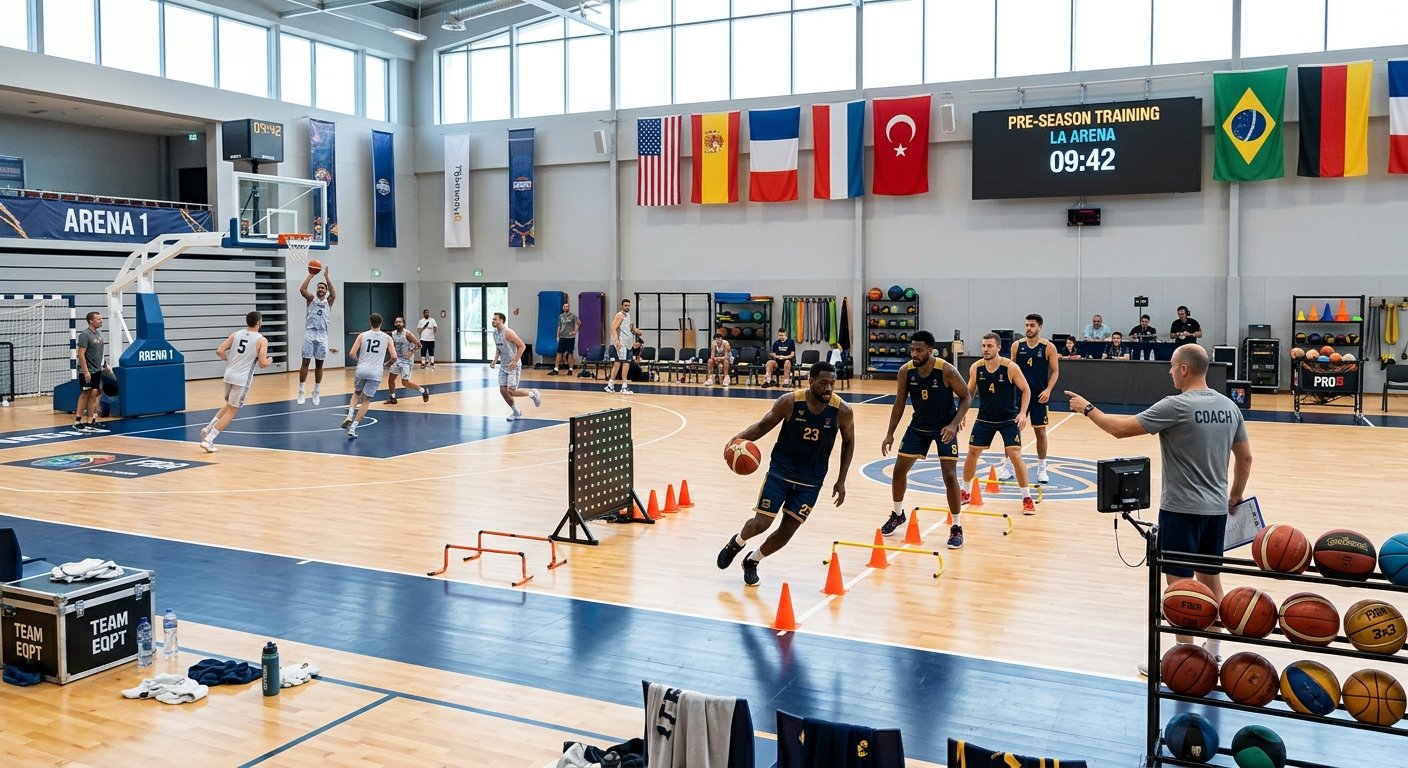
Planning basketball training in Los Angeles ahead of LA28? Whether your organization is preparing for traditional 5×5 basketball, 3×3 basketball, or both formats, choosing the right equipment starts with understanding their different requirements.
Although both formats use basketballs, baskets, and suitable playing surfaces, they differ in court layout, the number of baskets, game equipment, and certain ball specifications.
For international teams, sports federations, coaches, and event organizers, understanding these differences can make equipment sourcing and training-facility planning more efficient.
This guide compares 5×5 and 3×3 basketball training equipment and explains what to consider when renting or sourcing equipment in Los Angeles.
1. What Is the Difference Between 5×5 and 3×3 Basketball?
The main difference is the format of play.
5×5 basketball uses two teams of five players on the court and a full basketball court with two baskets.
3×3 basketball uses three players per team on the court and a half-court-style playing area with one basket.
These differences affect the court layout, basket requirements, basketball specifications, and equipment needed for training or events.
The equipment package should reflect the intended format rather than assuming that the same setup will serve every purpose.
2. 5×5 vs. 3×3 Basketball Equipment: Quick Comparison
The following table provides a starting point for equipment planning. Exact requirements depend on the intended use, venue, and applicable technical specifications.
| Equipment or requirement | 5×5 basketball | 3×3 basketball |
|---|---|---|
| Court layout | Full-court layout | Half-court-style layout |
| Standard playing area | 28 m × 15 m under FIBA rules | 15 m × 11 m under FIBA 3×3 rules |
| Basketball baskets | Two baskets | One basket |
| Basketball specification | Generally size 7 for men’s basketball and size 6 for women’s basketball under the relevant rules | Official 3×3 ball uses size 6 dimensions with the weight of a size 7 ball |
| Shot clock | 24-second shot clock in standard FIBA play | 12-second shot clock |
| Court markings | Full-court markings appropriate to the format | 3×3 markings appropriate to the format |
| Playing surface | Suitable full-court surface | Suitable 3×3 playing surface |
| Training accessories | Ball carts, training aids, and other items as required | Ball carts, training aids, and other items as required |
| Installation planning | Two-basket layout, court access, and equipment positioning | Single-basket layout, court access, and equipment positioning |
These dimensions describe the standard playing areas, not necessarily the entire space required at a venue. Additional clearance and operational space may be necessary.
For any project that requires compliance with specific FIBA rules or approval requirements, confirm the applicable current documentation before selecting equipment.
3. Basketball Hoop Systems: Two Baskets vs. One
One of the most visible differences between the formats is the number of baskets.
Equipment for 5×5 basketball
A full-court 5×5 setup generally requires two suitable basketball hoop systems, one at each end of the court.
When planning equipment, consider:
- The exact hoop system models.
- Backboard, rim, and net configuration.
- Basket height and other applicable specifications.
- Padding and safety considerations.
- Installation method and stability.
- Available space and venue access.
- Any technical or approval requirements specified for the project.
For a temporary training facility, the installation method is especially important. The venue must accommodate the proposed systems, and the floor conditions and manufacturer’s instructions must be reviewed.
Equipment for 3×3 basketball
A standard 3×3 setup uses one basket.
This can simplify some aspects of a temporary installation, but the selected system must still be suitable for the intended use and the applicable requirements.
Consider the support structure, backboard, rim, padding, stability, and installation arrangements.
If a project requires a FIBA-approved hoop system, verify the exact model and relevant documentation. Do not assume that all products from a recognized manufacturer have the same approval status.
4. Basketball Specifications: What Teams Should Check
Basketball selection is another important part of planning.
The ball requirements for 5×5 depend on the relevant category of play. Under standard FIBA rules, size 7 is used for men’s basketball and size 6 for women’s basketball.
FIBA 3×3 uses a specific ball specification: size 6 dimensions combined with the weight of a size 7 ball.
This means that a conventional size 6 or size 7 basketball should not automatically be treated as interchangeable with an official 3×3 ball.
Before arranging a rental or purchase, confirm:
- The intended basketball format.
- The required ball specification.
- The number of balls needed.
- Whether the balls will be used for training, warm-ups, or a regulated competition environment.
- Any applicable product or approval requirements.
Teams may also need ball carts and storage equipment to organize daily training sessions.
For international teams preparing to train in Los Angeles, documenting these requirements in advance can help avoid confusion when comparing supplier proposals.
5. Shot Clocks and Scoring Equipment
Shot-clock requirements are different for 5×5 and 3×3 basketball.
In standard FIBA 5×5 play, the shot clock is 24 seconds. In 3×3 basketball, the shot clock is 12 seconds.
If a training program or event requires a shot clock, the equipment must be appropriate for the intended format and the project’s technical requirements.
5×5 equipment considerations
Depending on the facility and training plan, the setup may include shot clocks associated with the basket systems and additional scoring equipment.
Confirm the required functionality, visibility, configuration, and compatibility with the proposed systems.
3×3 equipment considerations
A 3×3 setup may require a 12-second shot clock suitable for the intended application.
Before selecting the equipment, consider positioning, visibility, power requirements, installation arrangements, and any required integration with other equipment.
Not every training session requires the same scoring setup. Confirm what the team, organizer, or venue actually needs before adding equipment to the rental list.
6. Court Dimensions and Playing Surfaces
The two formats also differ in their playing areas.
Under standard FIBA rules, a 5×5 court measures 28 m × 15 m. The standard FIBA 3×3 playing area measures 15 m × 11 m.
These dimensions provide a reference for initial venue planning. However, the available installation space must also accommodate any required clearances, equipment access, and other operational needs.
Planning a 5×5 training court
A 5×5 facility requires a suitable full-court layout, two baskets, and appropriate court markings.
Before confirming the venue, check the playing area, surface condition, basket positions, access restrictions, and whether any additional flooring or protection is needed.
Planning a 3×3 training court
A 3×3 setup uses a smaller playing area and one basket, but the complete installation footprint may extend beyond the marked court.
The plan should account for court markings, basket positioning, equipment access, and the proposed surface.
Choosing temporary flooring
Depending on the project, teams may use an existing suitable sports floor or consider a temporary modular sports flooring system.
The correct option depends on the underlying surface, indoor or outdoor conditions, installation requirements, and intended use.
If the project specifies FIBA-approved flooring, verify the exact product and applicable approval category rather than relying on a general product description.
7. Which Training Accessories Are Shared?
Many training accessories can support both 5×5 and 3×3 basketball.
Depending on the training program, these may include:
- Ball carts.
- Basketball storage equipment.
- Cones and training markers.
- Agility and conditioning equipment.
- Rebounding and shooting aids.
- Equipment storage and transport solutions.
The appropriate quantity depends on the number of players, the training schedule, and the drills being conducted.
For example, a team running multiple training stations may need more basketballs and storage capacity than a group using a single basket for a short session.
A detailed equipment schedule helps distinguish essential items from optional accessories and supports more accurate rental planning.
8. Can the Same Equipment Be Used for Both Formats?
Some equipment can be shared between 5×5 and 3×3 activities, but not every item is automatically interchangeable.
Potentially shared items include certain training accessories, storage equipment, and basketballs that meet the requirements of the particular session.
Other equipment may need to be selected separately, including:
- Basketballs with the required specifications.
- Shot clocks configured for the intended format.
- Court markings and layout components.
- The number and positioning of baskets.
- Flooring or other products subject to specific technical requirements.
If an organization plans to switch between formats, the equipment schedule should identify which items will be shared, which will be changed, and what installation adjustments are required.
Do not assume that a single equipment package meets every competition-related requirement simply because it can physically be used for both formats.
9. Renting Equipment for 5×5 and 3×3 Training in Los Angeles
For teams visiting Los Angeles for a temporary training period or event, rental may be worth considering alongside purchasing.
Renting locally can reduce the need to transport and store certain equipment internationally. However, suitability, model availability, and the project schedule must be confirmed before making a decision.
When rental may be useful
Rental may be suitable when:
- Equipment is needed for a limited period.
- A team is using a temporary training facility.
- The venue does not already have all required equipment.
- Delivery and installation support are needed.
- Equipment will not be required after the project.
What to include in a rental inquiry
To help define the scope, provide:
- Basketball format: 5×5, 3×3, or both.
- Required court dimensions and number of baskets.
- Equipment list and quantities.
- Preferred models or technical specifications, if applicable.
- Training or event dates.
- Venue address and access information.
- Indoor or outdoor installation conditions.
- Delivery, setup, dismantling, and collection requirements.
If FIBA approval or another specific technical requirement applies, include it in the inquiry and identify the relevant documentation needed.
Rental availability and the exact scope of services should be confirmed for each project.
10. Planning Equipment for International Teams Ahead of LA28
International teams and sports federations may need to coordinate equipment sourcing, training venues, schedules, and logistics before arriving in Southern California.
A practical planning process includes the following steps.
Step 1: Define the format.
Confirm whether the program involves 5×5, 3×3, or both.
Step 2: Prepare the equipment schedule.
List the required hoop systems, basketballs, shot clocks, court surfaces, and training accessories.
Step 3: Confirm technical requirements.
Check the applicable rules and any specifications provided by the federation, event organizer, or venue.
Step 4: Review the venue.
Confirm the available playing area, installation conditions, access, and existing equipment.
Step 5: Evaluate sourcing options.
Compare rental and purchase options based on availability, duration of use, transport, and installation needs.
Step 6: Coordinate logistics.
Confirm delivery windows, setup responsibilities, dismantling, and equipment collection.
Starting this process early can help identify missing equipment, technical questions, and scheduling constraints before the training program begins.
11. Basketball Equipment Rental and Local Support in Los Angeles
HoopsMobile provides basketball equipment rental and related project support in Los Angeles and Southern California.
Depending on project requirements and availability, we can discuss professional basketball hoop systems, selected 3×3 equipment and court solutions, flooring options, training accessories, equipment sourcing coordination, and local delivery and installation.
Whether your organization needs a 5×5 training setup, a temporary 3×3 court, or equipment for both formats, the first step is to establish a clear list of requirements.
We can then discuss potential options


