How to Verify FIBA Approval for Basketball Equipment Before LA28
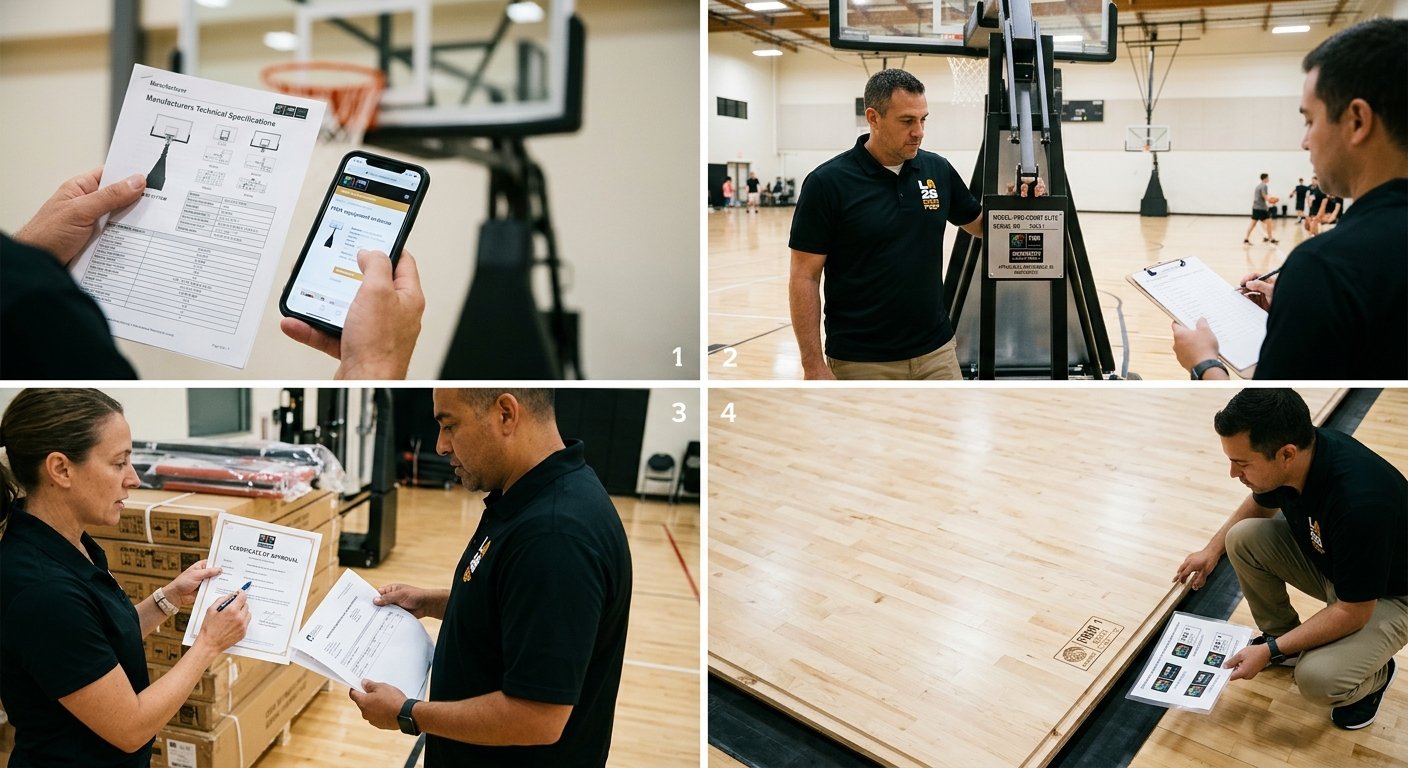
When preparing a basketball training facility or sports event in Los Angeles ahead of LA28, selecting the right equipment involves more than choosing a recognized manufacturer.
Some projects may require basketball equipment that meets specific FIBA technical requirements or holds an applicable FIBA approval. For teams, sports federations, venue operators, and event organizers, knowing how to verify these requirements is an important part of equipment planning.
A product description, supplier quotation, or manufacturer’s reputation should not be treated as sufficient proof of approval.
The verification process should focus on the exact product, its intended use, the applicable technical requirements, and reliable supporting documentation.
In this guide, we explain how to approach FIBA equipment verification before renting or purchasing basketball equipment for training and events.
1. Understand What Needs to Be Verified
Before checking a product’s approval status, identify the requirement that applies to your project.
There is an important difference between these three concepts:
- Technical compliance: A product meets specified technical characteristics or requirements.
- FIBA approval: A specific product has an applicable approval status under the relevant FIBA equipment approval program.
- Professional-grade equipment: A product is designed for professional or demanding basketball use, but this description alone does not establish FIBA approval.
These terms should not be used interchangeably.
Not every basketball equipment category is necessarily subject to the same approval process. Requirements can also differ depending on whether the equipment is intended for training, a regulated competition environment, or another application.
Start by confirming whether your project requires a particular FIBA-approved product, compliance with specified technical requirements, or another form of documentation.
If the requirement comes from a federation, event organizer, venue operator, or technical department, request the applicable specification in writing.
2. Identify the Exact Manufacturer and Model
The next step is to identify the exact product you intend to use.
A manufacturer’s name alone is not enough to establish the approval status of an individual product.
Before requesting a quotation or placing an order, record the following information where applicable:
- Manufacturer or brand
- Exact product name
- Model number or reference
- Product configuration
- Relevant technical specifications
- Intended use
- Any stated FIBA approval category or reference
This is particularly important when a manufacturer offers multiple basketball hoop systems, backboards, rims, flooring products, or other equipment under the same brand.
Two products from the same manufacturer may have different specifications and approval statuses.
If a supplier proposes an alternative model, verify that model separately rather than assuming that the original product’s documentation applies.
3. Consult Official FIBA Information
When FIBA approval is required, use current official FIBA information relevant to the product and approval category.
FIBA publishes basketball rules, technical information, and equipment-related resources. Its official website and relevant equipment approval resources are appropriate starting points for identifying applicable requirements.
During your review:
- Identify the relevant equipment category.
- Determine whether the category has specific FIBA approval requirements.
- Look for official information applicable to the exact product or model.
- Check any available product reference, approval listing, or supporting documentation.
- Confirm that the information relates to the intended application.
Do not rely exclusively on an old product brochure, a third-party marketplace listing, a social media post, or an unverified supplier statement.
If you cannot establish the product’s status from available official information, contact the manufacturer or the relevant FIBA equipment information channel for clarification.
Important: The absence of a product from a list you have consulted does not automatically prove that it is unapproved. First confirm that you are checking the correct category, current resource, and applicable approval program.
4. Request Supporting Documentation From the Supplier
Official information should be supplemented with product-specific documentation when necessary.
Ask the manufacturer or supplier to provide the documentation that supports the stated approval or compliance claim.
Depending on the equipment and the applicable requirements, useful information may include:
- Product technical datasheet
- Manufacturer’s model reference
- Applicable approval certificate or documentation, if issued
- Relevant official product or approval reference
- Installation and operating instructions
- Technical specifications required by the project
Not every document listed above will apply to every product. The purpose is to obtain evidence appropriate to the specific equipment category and requirement.
When reviewing documents, check that the product name, model, configuration, and manufacturer match the equipment being offered.
A document for a similar product or a different model should not automatically be accepted as evidence for the proposed item.
If a supplier states that a product is FIBA-approved but cannot provide enough information to substantiate the claim, request clarification before committing to the equipment.
5. Verify the Approval Claim at Product Level
Approval claims should be specific and traceable.
Consider the difference between these statements:
General claim:
“Our company supplies FIBA-approved basketball equipment.”
Product-specific claim:
“This exact product model has the following applicable approval reference, supported by the documentation provided.”
The second statement gives the buyer something concrete to verify.
When reviewing a product-specific claim, check:
- Does the model reference match the quotation?
- Does the supporting document identify the same product?
- Is the document relevant to the approval category required?
- Is the information current enough for the intended project?
- Are there any stated conditions, limitations, or configuration requirements?
- Does the proposed installation match the approved or documented configuration, where applicable?
The appropriate verification method depends on the product category and the documentation available.
If there is uncertainty about the interpretation of an approval or technical requirement, seek clarification from the manufacturer or the relevant official source.
6. Check Basketball Hoop Systems Carefully
Basketball hoop systems can include several components, such as a support structure, backboard, rim, net, padding, and related accessories.
When evaluating a hoop system, make sure the proposed equipment matches the project requirements.
Confirm the model and configuration
Record the exact hoop system model and the configuration being offered.
If the quotation describes a complete system, clarify which components are included. A product name alone may not identify every component or configuration.
Review technical requirements
Depending on the intended use, relevant considerations may include backboard dimensions, rim configuration, basket height, support structure, padding, stability, and installation requirements.
Use the applicable technical specifications rather than assuming that all professional hoop systems have identical characteristics.
Check the documentation
If FIBA approval is required, verify the specific system and relevant category using the appropriate documentation.
Do not assume that approval for one hoop model automatically applies to another model from the same manufacturer.
Confirm the installation conditions
Even when the equipment itself is suitable, the venue and installation method must be considered separately.
Review the available space, access route, floor conditions, required clearances, stability requirements, and manufacturer’s installation instructions.
These practical checks are especially important for temporary training facilities.
7. Verify Basketball Flooring and Other Equipment Separately
FIBA approval requirements should not be assumed to apply uniformly across all basketball equipment categories.
Flooring, basketballs, hoop systems, shot clocks, and other products have different technical characteristics and may be subject to different requirements.
Basketball court flooring
If a project specifies FIBA-approved flooring, identify the exact flooring product and applicable approval category.
Ask for supporting documentation and check that the product proposed in the quotation matches the product identified in the documentation.
Also review the intended application, court dimensions, installation conditions, and any requirements relating to the underlying surface.
Basketballs
Confirm the required ball specifications and intended basketball format.
If a specific approval is required, check the exact product and relevant documentation rather than relying only on the manufacturer’s reputation or a general product description.
Shot clocks and scoring equipment
For equipment such as a 12-second shot clock used in 3×3 basketball, establish the required functionality, compatibility, and any applicable technical or approval requirements.
The equipment specification should reflect the intended use and the responsible organization’s requirements.
Accessories and supporting equipment
Items such as ball carts and storage equipment may be evaluated primarily on suitability, dimensions, durability, and operational requirements.
Do not assume that every accessory requires the same type of approval as competition equipment. Verify the actual requirement for each category.
8. Use a Verification Checklist Before Renting or Purchasing
A simple checklist can make the process more consistent and help identify missing information before a commitment is made.
| Verification item | Questions to ask |
|---|---|
| Project requirement | What exact technical or approval requirement applies? |
| Product identity | Is the manufacturer and exact model clearly identified? |
| Product category | What approval or compliance requirements apply to this category? |
| Official information | Have the relevant current official resources been checked? |
| Supporting documentation | Has the supplier provided appropriate evidence for its claim? |
| Model match | Do the quotation, product label, and documentation identify the same product? |
| Configuration | Does the offered configuration match the documented product? |
| Installation | Are the installation method and venue conditions suitable? |
| Availability | Is the exact model available for the required dates? |
| Final confirmation | Have unresolved technical questions been clarified before commitment? |
Keep the relevant documentation with the project equipment schedule and quotation records.
For a project involving multiple products, track the verification status of each item separately. Confirming one product does not verify every item in the equipment package.
9. Questions to Ask a Basketball Equipment Supplier
If you are sourcing basketball equipment for an LA28-related training project, these questions can help clarify a supplier’s proposal.
- What is the exact manufacturer and model of the proposed equipment?
- Does this specific product have an applicable FIBA approval status, if required for our intended use?
- Which official reference or supporting document substantiates the claim?
- Does the documentation match the exact model and configuration in the quotation?
- Are there any technical requirements or installation conditions we need to consider?
- Is the proposed equipment available for our required dates?
- Are delivery, installation, dismantling, and collection included in the quotation?
- If the requested model is unavailable, will any proposed alternative be identified separately for review?
These questions help separate technical verification from commercial and logistical planning.
A product may meet the project’s technical requirements but be unavailable for the requested dates. Conversely, an available product may not satisfy a particular approval requirement. Both issues should be resolved before the equipment plan is finalized.
10. What International Teams Should Do Before Arriving in Los Angeles
International teams and sports federations may be coordinating equipment, venues, transport, and training schedules from outside the United States.
Starting the verification process early can help identify products that require advance sourcing or additional technical review.
A practical preparation process is to:
Step 1: Prepare an equipment schedule.
List the required equipment, quantities, intended use, and target dates.
Step 2: Record technical requirements.
Include any specifications or approval requirements provided by the federation, event organizer, or venue.
Step 3: Identify exact products.
Record preferred manufacturers and model references where available.
Step 4: Verify documentation.
Check applicable official resources and request supporting documents from suppliers.
Step 5: Review rental and purchase options.
Compare options based on availability, technical suitability, duration of use, transportation, and installation needs.
Step 6: Coordinate local logistics.
Confirm delivery access, installation windows, venue conditions, dismantling, and equipment collection.
This process can help organizations identify potential gaps before arriving in Los Angeles and reduce the risk of last-minute changes.
11. How HoopsMobile Can Help With Equipment Planning
HoopsMobile provides basketball equipment rental and related project support in Los Angeles and Southern California.
Depending on project requirements and availability, our team can discuss professional basketball hoop systems, selected 3×3 equipment and court solutions, flooring options, equipment sourcing coordination, and local delivery and installation.
If your project requires specific FIBA-approved equipment, share the applicable specifications and documentation requirements at the beginning of the discussion.
This allows the proposed equipment to be evaluated against the stated requirements rather than relying on assumptions about a brand or product category.
Product availability, exact models, approval status, and the scope of services must be confirmed for each project.
HoopsMobile is an independent service provider and does not claim to be an official LA28 or FIBA supplier.
Final Checklist: Verify Before You Commit
Before confirming a basketball equipment rental or purchase for an LA28-related project, make sure you have:
- Identified the exact product and model.
- Established the technical or approval requirements for the intended use.
- Consulted the relevant current official information.
- Requested and reviewed appropriate supporting documentation.
- Confirmed that the documentation matches the proposed product.
- Clarified any remaining technical questions.
- Checked availability, installation conditions, and logistics.
Planning basketball training in Los Angeles ahead of LA28?
Contact HoopsMobile to discuss basketball equipment rental, potential sourcing options, and local project support.
This article provides general planning guidance and does not constitute official confirmation of any product’s FIBA approval status. Approval requirements and documentation should be verified through current relevant official sources and the responsible manufacturer or organization. HoopsMobile is an independent provider and is not affiliated with or endorsed by LA28 or FIBA.


